5-Axis CNC Machining: One Setup, Fewer Compromises
5-axis gets sold as exotic. On our floor it's a scheduling decision: for parts with features facing multiple directions, one 5-axis setup replaces two or three 3-axis setups — and every removed setup removes fixturing cost, stack-up error and days of lead time. This page explains what our 5-axis cells do, when they're the cheaper route even at a higher hourly rate, and when honest quoting says 3-axis instead.
What 5-axis actually buys you
- Feature access in one clamping. Angled faces, cross-holes, undercuts and curved ports machine without re-fixture — the tolerance between features no longer depends on the operator re-datuming twice.
- Shorter, stiffer tools. The rotary axes tilt the part so the tool meets each feature from the best angle. Shorter tools deflect less, so walls come out straighter and finishes come out better — the physics behind holding ±0.005 mm consistently.
- Fewer operations, fewer handoffs. One program, one setup, one inspection. The eliminated ops are usually where schedules slip.
- Better surface finish on 3D curves. Continuous tool contact at optimal angle, instead of stair-stepped 3-axis passes on sculpted surfaces.
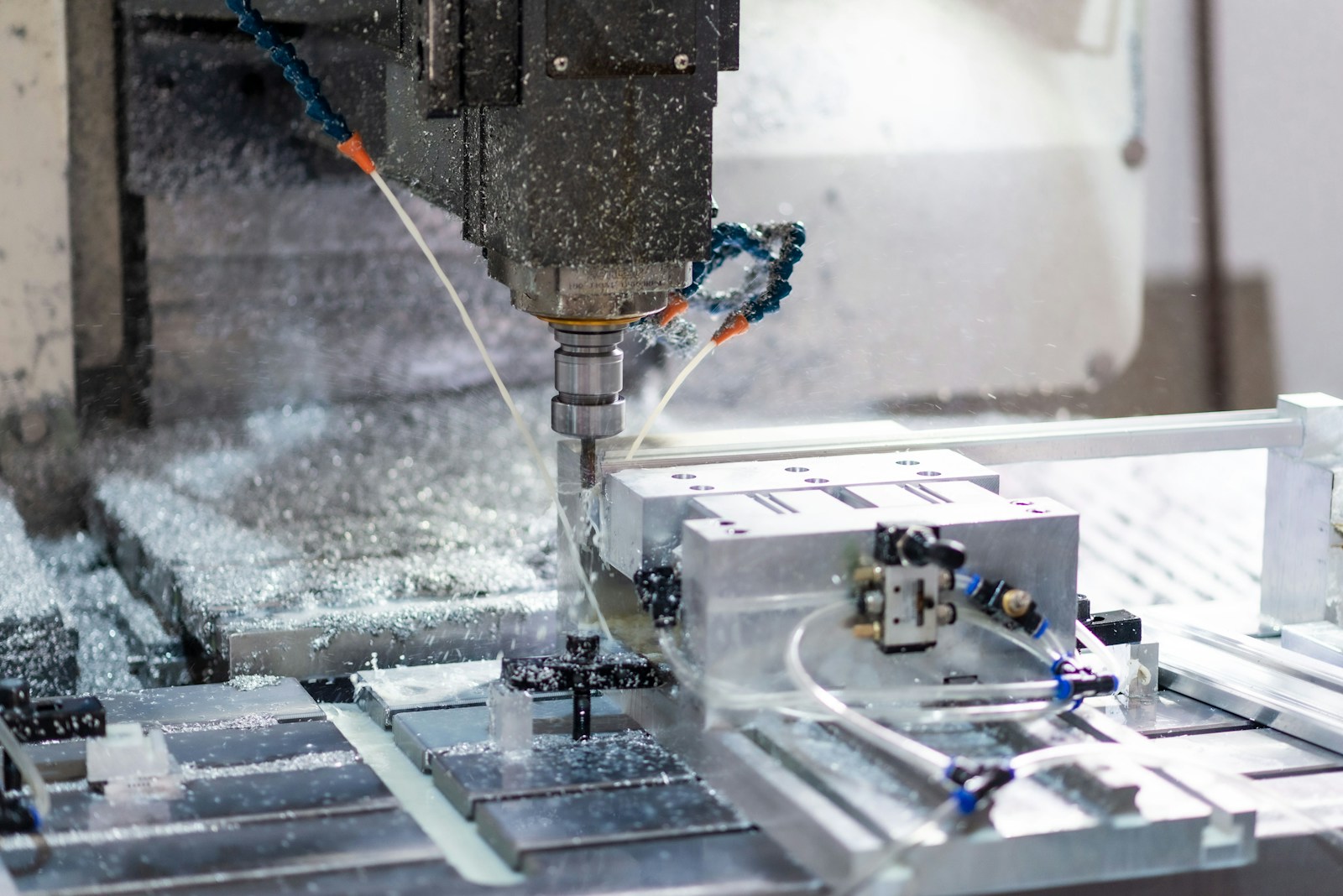
5-axis vs 3-axis: the real cost comparison
| Part type | Better route | Why |
|---|---|---|
| Flat brackets, plates, simple pockets | 3-axis | Nothing needs an angle; 5-axis rate buys nothing |
| Housings with features on 2–4 faces | 4-axis or two-setup 3-axis | Rotary reposition without full 5-axis programming cost |
| Impellers, manifolds, curved ports, orthopedic-style geometry | 5-axis | Features demand continuous tool angle |
| Tight true-position between faces of an angled part | 5-axis | Single setup eliminates stack-up error |
| Deep, narrow cavities | 5-axis | Tool tilts to reach; short tools replace long fragile ones |
How we hold tolerance on 5-axis work
- On-machine probing. Parts are probed after roughing; the finish passes compensate for actual stock state instead of assuming perfect blank geometry.
- Thermal discipline. Warm-up cycles, coolant temperature control and finishing passes only after thermal equilibrium — the difference between "the machine can do ±0.005" and "the shop does it every day."
- Simulation before steel. Every simultaneous 5-axis program is collision-checked and verified in CAM before touching stock — a scratch on a 5-axis part usually means scrap, so we don't discover collisions at the machine.
- CMM verification on the datums that matter. Single-setup parts make inspection straightforward: the datums you machined to are the datums we measure from.
Design notes for 5-axis parts
- Give the part a machining datum face. One flat, accessible reference makes fixturing simpler and quotes lower — even on 5-axis.
- Radius corners generously. A Ø6 mm tool with an R3 corner reaches most angled features; forcing R1 tools multiplies cutting time on every flank.
- Mark which tolerances are between features. On multi-face parts, the true-position between an angled bore and a face is the number that justifies 5-axis — call it out explicitly so we machine and verify the right thing.
Frequently asked questions
Do you do simultaneous 5-axis or just 3+2?
Both. Most "5-axis" parts on our floor are 3+2 (positioned rotary) — the geometry needs access, not continuous contouring. True simultaneous 5-axis runs for impellers, blades and sculpted surfaces where the tool must move in five axes at once. We pick the route that machines the part fastest to spec, not the one with the fancier name.
What's your largest 5-axis envelope?
Travels to 650 × 600 × 550 mm on our 5-axis mills; larger parts route to our 3-axis cells with rotary fixtures. Send the STEP file — envelope feasibility comes back with the quote, not after it.
Is a STEP file required for a 5-axis quote?
Strongly recommended. CAM programming runs from exact geometry; a PDF alone forces us to model the part first, which adds a day and a question list. Send STEP + PDF together and the quote usually lands the same day.
Related: CNC turning services · 7075 for structural 5-axis parts · Our full capability overview